
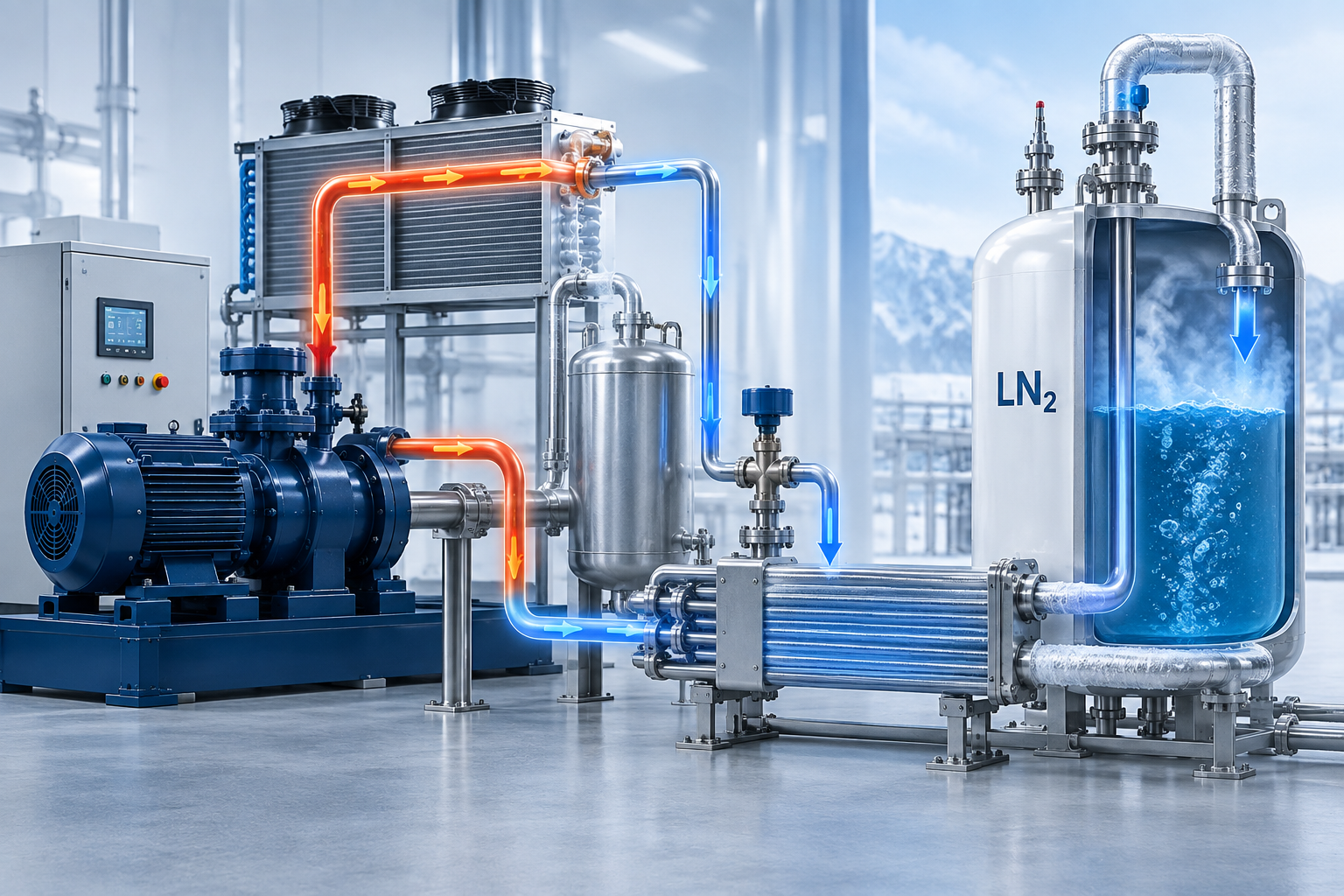
Understanding Cryogenic Refrigeration Systems
Cryogenic refrigeration is the technology used to achieve and maintain extremely low temperatures for scientific, research and specialized industrial applications.
At these temperatures, conventional refrigeration technologies are often not sufficient. Cryogenic systems therefore use specialized refrigeration cycles, heat exchangers, compressors and other components designed to operate under demanding conditions.
One important approach is the use of closed-cycle helium cryocoolers, where helium is circulated continuously through the system.
What Is a Cryogenic Refrigeration System?
A cryogenic refrigeration system is an engineered system designed to remove heat and achieve temperatures significantly below those normally reached by conventional refrigeration equipment.
Depending on the application and system design, cryogenic refrigeration can be used to reach temperatures in the tens of kelvin.
A typical closed-cycle system consists of:
- Helium compressor
- Cryogenic refrigerator or cold head
- Heat exchangers
- High- and low-pressure helium lines
- Control and monitoring components
- Cooling-water system where required
All these components need to work together to provide stable refrigeration.
How Does a Cryogenic Refrigeration System Work?
A simplified closed-cycle helium refrigeration process can be explained in several stages.
Step 1: Helium Compression
The helium compressor increases the pressure of the circulating helium gas.
The high-pressure helium is then supplied to the refrigerator.
Step 2: Heat Exchange
The helium passes through heat-exchange stages that help reduce its temperature as it moves through the refrigeration system.
Step 3: Expansion and Cooling
The refrigeration cycle uses expansion processes to achieve very low temperatures.
The resulting cold helium is used to absorb heat from the application or experimental environment.
Step 4: Heat Removal
Heat from the cooled system is transferred into the refrigeration cycle and ultimately rejected through the appropriate heat-rejection mechanism.
Step 5: Helium Returns to the Compressor
The lower-pressure helium returns to the compressor, where the cycle begins again.
This continuous circulation is one of the key characteristics of a closed-cycle cryogenic refrigeration system.
Major Components of a Cryogenic System
1. Helium Compressor
The lower-pressure helium returns to the compressor, where the cycle begins again.
This continuous circulation is one of the key characteristics of a closed-cycle cryogenic refrigeration system.
2. Cryogenic Refrigerator
The refrigerator or cold head is responsible for producing the low-temperature cooling required by the application.
For example, RJ Instruments’ REF30K refrigerator is specified for cooling performance in the 30 K temperature range.
3. Helium Transfer Lines
High-pressure and low-pressure helium lines connect the compressor and refrigerator.
These lines need suitable connections and leak-tight construction.
4. Heat Exchangers
Heat exchangers allow thermal energy to be transferred between different parts of the refrigeration cycle.
Their performance has a direct effect on the efficiency of the cooling process.
5. Control System
Monitoring pressure, temperature and other operating parameters helps maintain stable system operation and assists with troubleshooting.
Why Is System Integration Important?
A cryogenic system is more than a collection of individual components.
The compressor, refrigerator, transfer lines and supporting equipment must be properly matched.
Incorrect operating conditions can affect:
- Cooling performance
- System stability
- Energy consumption
- Component life
- Maintenance requirements
This is why engineering the compressor and refrigerator as a coordinated system can be important for demanding applications.
Where Are Cryogenic Refrigeration Systems Used?
Cryogenic refrigeration technology has applications in several fields, including:
Scientific Research
This is why engineering the compressor and refrigerator as a coordinated system can be important for demanding applications.
Laboratory Applications
Specialized laboratories may require controlled low-temperature environments for experiments and testing.
Cryocooler Systems
Closed-cycle cryocoolers provide cooling without requiring continuous consumption of liquid cryogens.
Industrial Applications
Specialized industrial processes can also require controlled cryogenic temperatures.
Advantages of Closed-Cycle Cryogenic Cooling
One of the important benefits of a closed-cycle system is the continuous circulation of the working gas.
This can help reduce dependence on continuously supplied liquid cryogens for applications designed around mechanical cryocooling.
Other considerations include:
- Reusable helium circulation
- Controlled cooling
- Continuous operation
- Compact system designs
- Integration with specialized equipment
RJ Instruments and Cryogenic Technology
RJ Instruments focuses on helium compression and cryogenic refrigeration solutions.
Its product portfolio includes the HelioPulse3k helium compressor and the HELIOREF30K cryogenic refrigeration system.
The HELIOREF30K integrates the HelioPulse3k compressor with the REF30K refrigerator to provide a coordinated cryogenic cooling solution.
Conclusion
Cryogenic refrigeration systems combine specialized compression, refrigeration and heat-transfer technologies to achieve extremely low temperatures.
Understanding how the compressor, refrigerator and supporting components work together is essential when designing or selecting a cryogenic system.
For demanding applications, system reliability, serviceability, leak prevention and proper component integration should all be considered from the beginning.